Freetown Christiania Copenhagen: the autonomous zone (2026)
Ways to experience Christiania
There are four main ways to see Freetown Christiania: a solo walk guided by street names and murals, a walking tour led by residents, a bike tour to see the lake and ramparts, or paired with a food tour through the alternative dining scene.
Freetown Christiania walking tour
Resident-led walk (90 min) departing weekends, exploring the history, self-government, and current residents. No photos in sensitive areas; guides explain the ethics. The most respectful way to understand the place.
Bike tour: Christianshavn canals + Freetown
Pair a Christianshavn canal bike ride (30 min) with entry to Freetown (90 min). Shows the old military barracks, the lake visible from Christiania, and the rampart landscape. Best in spring and summer.
Check ticketsCopenhagen Card
The 24-120 h city card includes public transport and 80+ attractions. If Christiania is one of many stops, and you’re using the metro and trains, the Card often saves EUR 10-20.
Check ticketsFreetown food tour + visit
Half-day or full-day food tour visiting Morgenstedet (vegetarian), Byens Lys (organic), and street food vendors. Combined with a walk through the community. Led by guides who know the restaurant history.
The best time to visit is 12:00 to 17:00 on a weekend. Cafes and shops are open, residents are around, and the morning Saturday market adds energy. Weekday evenings can feel quieter and less welcoming.
Highlights
- The main gate — red steel arch entrance on Prinsessegade; cross it and the city’s rules visibly change.
- Street murals and art — hand-painted houses, sculptures, and installations throughout the lanes; some walls are living galleries.
- Self-built architecture — wooden houses designed and built by residents; utterly unlike the rest of Copenhagen.
- Nemoland flea market — open Fridays and weekends; vintage goods, handmade crafts, and a window into the DIY culture.
- The rampart lake and grounds — 84 acres of green space surrounding the old military fortifications; walking trails and quiet spots away from the city.
What to do in Freetown Christiania
Christiania rewards wandering. There are no paid attractions, no gift shops, and no controlled routes. Simply explore, look, and sit.
The main gate and entrance plaza
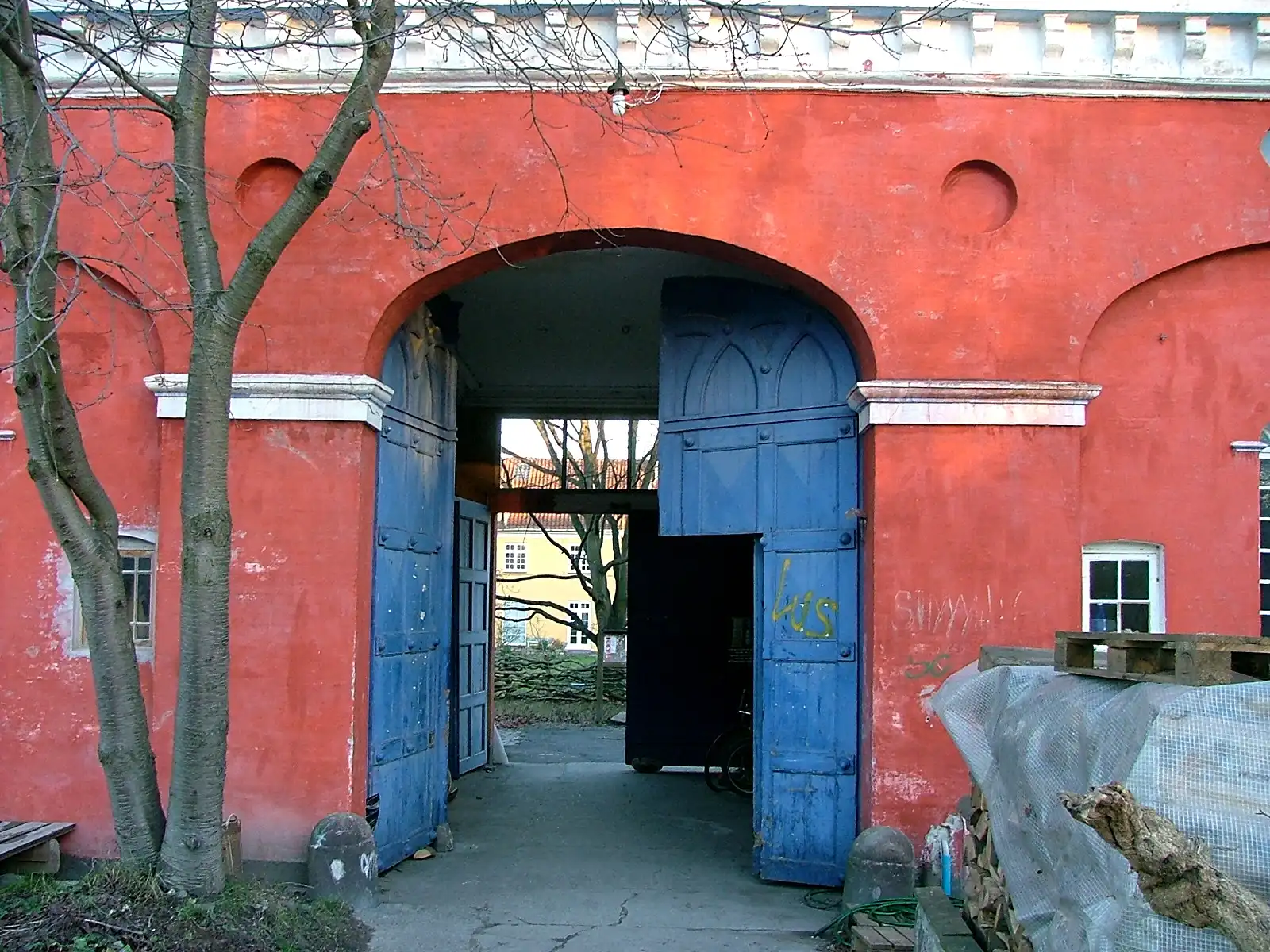
The red steel gate is the symbolic entry point. Beyond it: no chains, no corporate signs, no noise barriers, and no cars (except service and emergency vehicles). The plaza just inside hosts a market on summer weekends and occasional open-air concerts. The gate itself is a photo spot (allowed), but inside the residential lanes, ask before shooting.
Walk in slowly. The contrast is jarring: you’ll go from busy Prinsessegade to car-free lanes with vegetable gardens and string lights in 30 seconds.
Self-built houses and the winding lanes
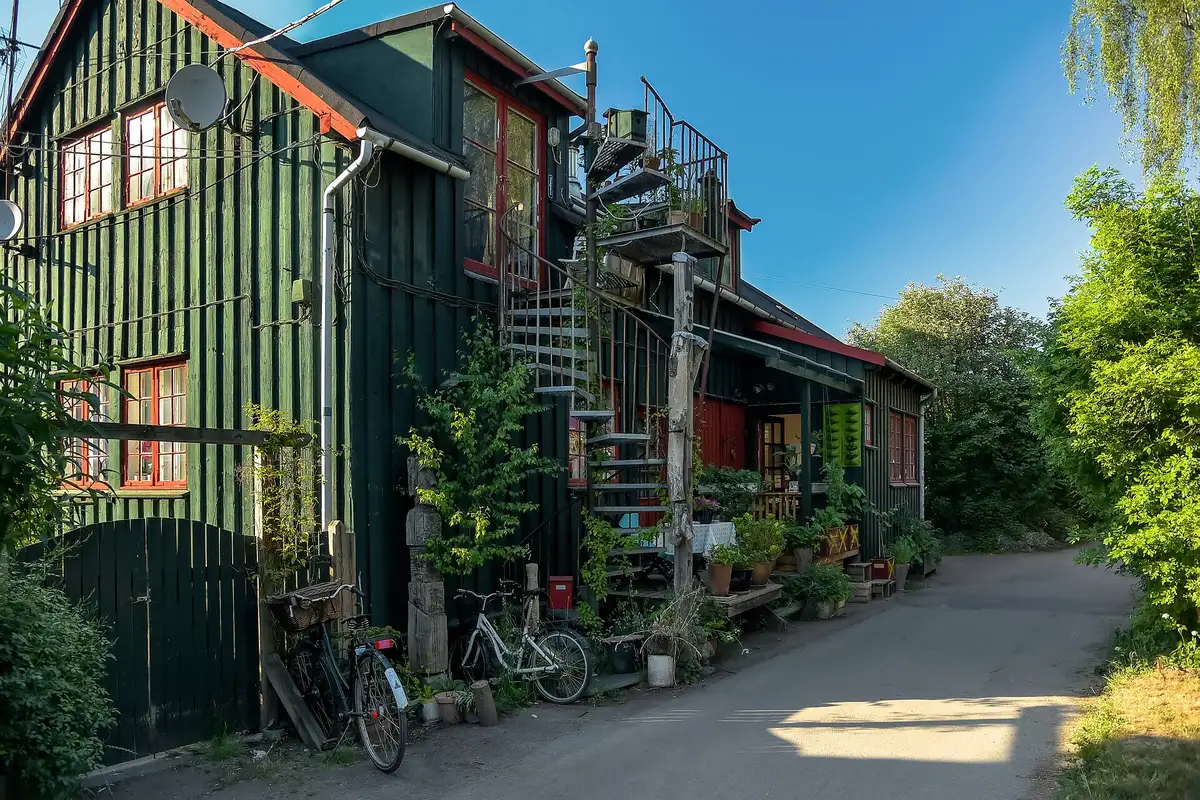
The heart of Christiania is the architecture. Residents built nearly every structure themselves, and it shows: no two houses match. You’ll see wooden houses painted in primary colours, recycled materials repurposed as walls and roofs, and organic curves that ignore Copenhagen’s grid. The lanes twist around the old fortification ramparts, and the greenery is wild—gardens spill into paths, and the lake is visible from several viewpoints.
Photography: some areas (like Pusher Street, now a flea market) have explicit “no photos” signs. In residential areas, ask residents before shooting people or their homes. The community is wary of documentation that might be used against them politically; respect that boundary.
Nemoland flea market and Pusher Street (post-2024)
Pusher Street was the open-air drug market, a controversial draw and a defining part of Christiania’s identity for 50 years. In 2023, residents voted to demolish it and clear the drug trade. It was dug up in early 2024. The site is now Nemoland, a flea market with vintage goods, secondhand records, and handmade crafts. The change reflects a shift in the community: Christiania is reinventing itself as a cultural and artistic space, not a drug haven. Locals see it as a necessary evolution.
Cafes and food
Morgenstedet (Garden Cafe) is the iconic spot: vegetarian, organic, and run as a cooperative. Tables spill onto a patio facing the ramparts. Mains are EUR 10-15; payment is cash or card. Byens Lys (City Lights) is a cosy indoor cafe with a bookshop vibe, serving coffee, pastries, and light meals. Pusher Bar (yes, it still exists, on the old Pusher Street edge) serves organic beer and snacks. All three are run by residents and designed around community, not profit.
Street art and workshops
Murals cover buildings throughout Christiania. Some are permanent, others repainted yearly. The art reflects the community’s values: anti-authoritarian messages, environmental themes, and abstract designs. Wooden signs and hand-painted maps guide you, but there’s no formal gallery; the streets are the art.
If you wander deeper, you’ll find workshops: woodworking studios, printmakers, painters, and music rehearsal spaces. During the annual Christiania Festival (May/June), many open their doors. Most of the year, they’re private spaces, but the doors being open or closed signal whether visitors are welcome.
Photography rules: respect and ethics
Christiania has a troubled history with photography and surveillance. For decades, drug enforcement and media outlets treated the community as a spectacle. Today, residents ask visitors to be thoughtful. Do: ask before photographing people, respect “no photos” signs, and think about what you’re shooting. Don’t: photograph from outside the gate to sell images, focus on drug activity or homeless people, or treat it as a petting zoo. The community is not a museum; it’s a home to 900+ people.
History: from military barracks to autonomous zone (1971-2026)
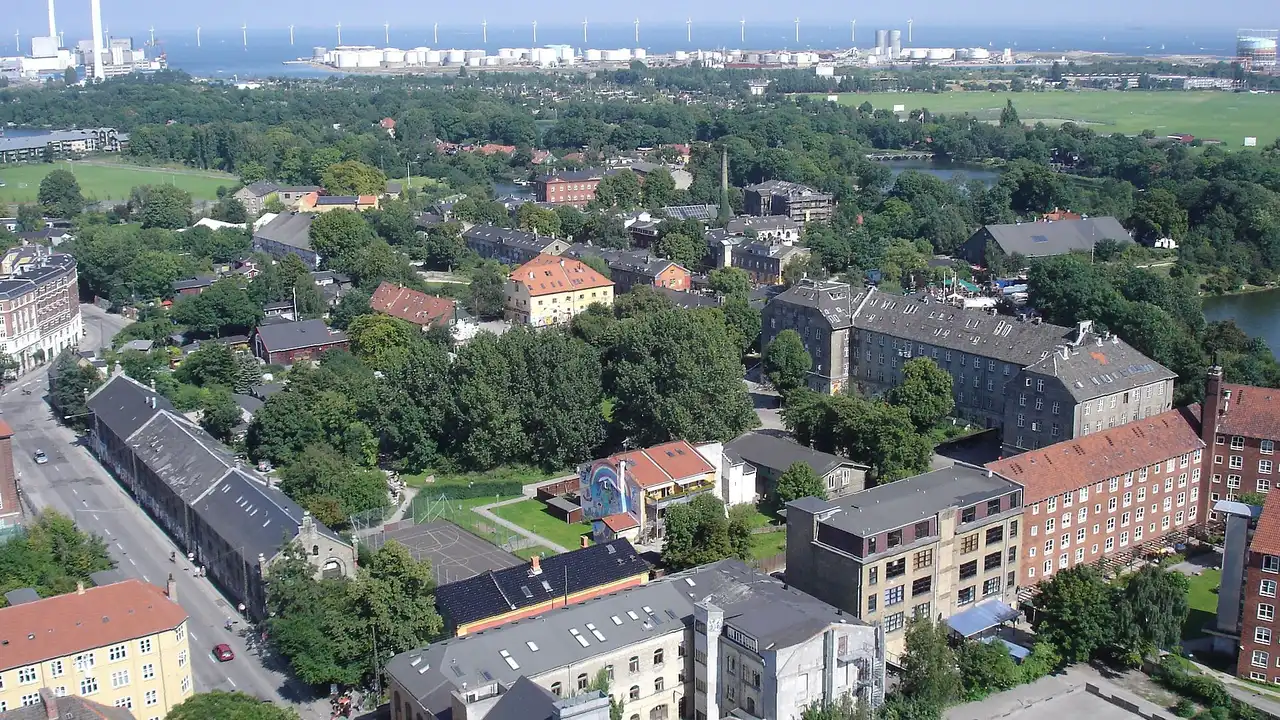
Freetown Christiania began in 1971 when squatters occupied an abandoned military barracks (Bådsmandsstræde) in the Christianshavn district. The Danish government tolerated it as an experiment; Christiania developed its own rules, elected a council, and operated as a self-governing commune for 50 years. In 2011, a landmark agreement allowed residents to buy the land from the state via Fonden Fristaden Christiania (a foundation). Today, residents pay rent to the foundation (not the state), and the neighbourhood is semi-official: recognised but not controlled.
How to get to Christiania
By metro or train
Metro lines M1 and M2 stop at Christianshavn station, a 7-8 minute walk from the main gate: exit onto Torvegade, turn left onto Prinsessegade, and follow it past the church. From the airport, the M2 runs direct to Christianshavn in about 11 minutes — see airport to city for the options.
On foot or by bike
From Christiansborg Palace (10 min walk) head southeast along the canal. From Nyhavn (15 min walk), head west along the water. Bike is ideal: there’s parking and a bike path the whole way. The entrance is on Prinsessegade, which runs along the old fortification rampart.
What things cost in Christiania
Entry is free and nobody will ask you for money. What you spend depends on how long you stay and whether you eat. Prices are noticeably lower than the city centre — one of the few places in Copenhagen where that is true.
| Item | Typical price | Where |
|---|---|---|
| Coffee | EUR 3-4 | Cafe Nemoland, Woodstock |
| Local beer | EUR 5-6 | Cafe Nemoland, Byens Lys |
| Vegetarian lunch plate | EUR 12-16 | Morgenstedet |
| Guided community tour | Around EUR 10 | Resident-run, weekends from the main gate |
| Cargo-bike workshop visit | Free to browse | Christiania Cykler |
Bring cash or a card — most cafes take cards now, but some stalls and the weekend tour are cash-only. There is no ATM inside; the nearest is on Torvegade.
How much time to spend
Plan on 1.5 to 2 hours for a relaxed loop: the main drag, the lake path along the old ramparts, a coffee stop, and the craft workshops. Rushing it in 30 minutes gets you the murals and the gate photo and nothing of the atmosphere, which is the whole point of coming. With a lunch at Morgenstedet, budget a half day. It pairs naturally with Christiansborg across the water for a full Christianshavn day.
Dos and don’ts
Do
- Walk slowly and observe. The details—murals, gardens, handmade signs—reward attention.
- Buy food or coffee at Morgenstedet or another cafe; your money goes directly to residents.
- Ask residents questions. Most are friendly and proud to explain the place.
- Visit during the day (12:00-17:00) and weekends when the community is most active.
- Respect “no photos” signs and ask permission in residential areas.
Don’t
- Don’t buy drugs. The community has banned the trade; there are no dealers.
- Don’t treat it as a photo safari or spectacle. It’s a real neighbourhood.
- Don’t wander into residential gardens or private workshops without asking.
- Don’t visit late evening alone or after dark; it’s less welcoming then.
- Don’t expect English signage or maps; come prepared to get lost and ask for directions.
Nearby: what to combine Christiania with
Christiania sits at the edge of Christianshavn district, which is rich with other stops. Walk north along the canal to the canal cruise pier at Gammel Strand (20 min), visit Christiansborg Palace and its free tower (15 min), or cross the bridge to Nyhavn (20 min). The one-day itinerary pairs Christiania with the city centre, and three days in Copenhagen gives it a full morning or afternoon slot. For food, Copenhagen’s food scene includes Christiania’s cafes as a counterpoint to formal dining.
Did you know? Five Christiania facts
- Freetown Christiania was founded on Bådsmandsstræde, a military barracks built in the 1600s. The name means “Boatswain’s Street” in Danish.
- The cargo bike (a pedal-powered flatbed bike used throughout Copenhagen for moving goods and children) was invented in Christiania in the 1970s and is still built by residents.
- In 1989, the Danish government gave Christiania “social experiment” status, officially tolerating it as a test in alternative living.
- Bob Dylan performed at the Grey Hall (an open-air venue on the edge of Christiania) in the 1990s; the venue still hosts concerts and is one of the best acoustic spaces in Copenhagen.
- The 2024 demolition of Pusher Street was the residents’ own decision, made by majority vote. It signals a conscious shift from counterculture defiance to cultural sustainability.
A short history
| Year | What happened |
|---|---|
| 1971 | Squatters occupy the abandoned Bådsmandsstræde military barracks; Freetown Christiania is born. |
| 1977 | The cargo bike is invented in Christiania; it becomes a symbol of the community and is still used across Copenhagen. |
| 1989 | The Danish government officially recognises Christiania as a social experiment and allows it to continue. |
| 1994 | The grey hall opens as a concert venue; major acts begin performing on the rampart. |
| 2011 | Landmark agreement signed: residents can buy the land from the Danish state via Fonden Fristaden Christiania. |
| 2023 | Residents vote to demolish Pusher Street and end the drug market. |
| 2024 | Pusher Street is dug up; Nemoland flea market takes its place. Christiania officially closes the drug chapter. |
Frequently asked questions
Is Christiania safe?
Yes. It’s well-visited and safe during the day. Avoid after dark if you’re not familiar with the area. Don’t carry expensive gear.
Can I buy drugs in Christiania?
No longer openly. Pusher Street (the open market) was demolished in 2024. The neighbourhood has actively removed the drug scene.
Can I stay overnight in Christiania?
Not in tourist accommodations. It’s not a hotel destination. You can walk and eat, but you must leave. Residents live here.
How long should I spend in Christiania?
1 to 2 hours for a walk and cafe. 2 to 3 hours if you browse the shops and flea market.
What’s the best cafe in Christiania?
Morgenstedet (vegetarian, cosy outdoors) and Byens Lys (traditional Danish, hygge) are the most popular with visitors. Both are casual and cheap (EUR 8 to 15 per meal).
Is Christiania still countercultural?
Yes, the vibe is intentionally alternative and bohemian. But it’s also become gentrified and tourist-friendly. The raw edge is dulled compared to the 1980s and 90s.