Amalienborg Palace Copenhagen: royal residence and changing of the guard (2026)
Amalienborg tickets and attractions
Amalienborg has two main draws. The square and guard ceremony are entirely free and visible from the public plaza. The museum (in one of the four palaces) is optional if you want to see royal rooms and furniture. Most first-time visitors come for the guard change, take photos of the rococo facades, and skip the museum entirely.
Royal rooms and furniture
Christian VIII’s Palace (northeast corner), home to the museum of royal life. See royal bedrooms, dining halls, furniture, royal portraits, and intimate personal items. Audio guides in five languages. Allow 45 to 60 minutes. Quieter than the square outside.
Check ticketsTwo-palace combo ticket
Amalienborg Museum plus Rosenborg Castle (Crown Jewels, 15 min walk away). One ticket, two palaces, both with audio guides. Best value if you want to see both royal residences and the jewels on the same day.
Copenhagen Card
24 to 120 hour pass: entry to Amalienborg, Rosenborg, Christiansborg, Tivoli, and 75+ other museums, plus all public transport. Excellent if doing a palace and museum crawl.
Check ticketsExpert palace tour
Join a group tour (weekends) or book a private guide to learn the stories behind each palace, the royal family, and Danish traditions. Includes museum access and narration you won’t get alone. Book ahead.
Check ticketsArrive at the square by 11:45 to get a good spot for the guard change at 12:00 noon. The Royal Guard marches from Rosenborg Castle (11:30 departure), arriving at Amalienborg at 12:00 on the dot. Afterwards, walk to the adjacent Marble Church (Marmorkirken) or stroll toward Nyhavn (5 min away).
Highlights
- The Changing of the Guard at noon — free daily ceremony with uniformed soldiers, marching band, and formal drill in the square.
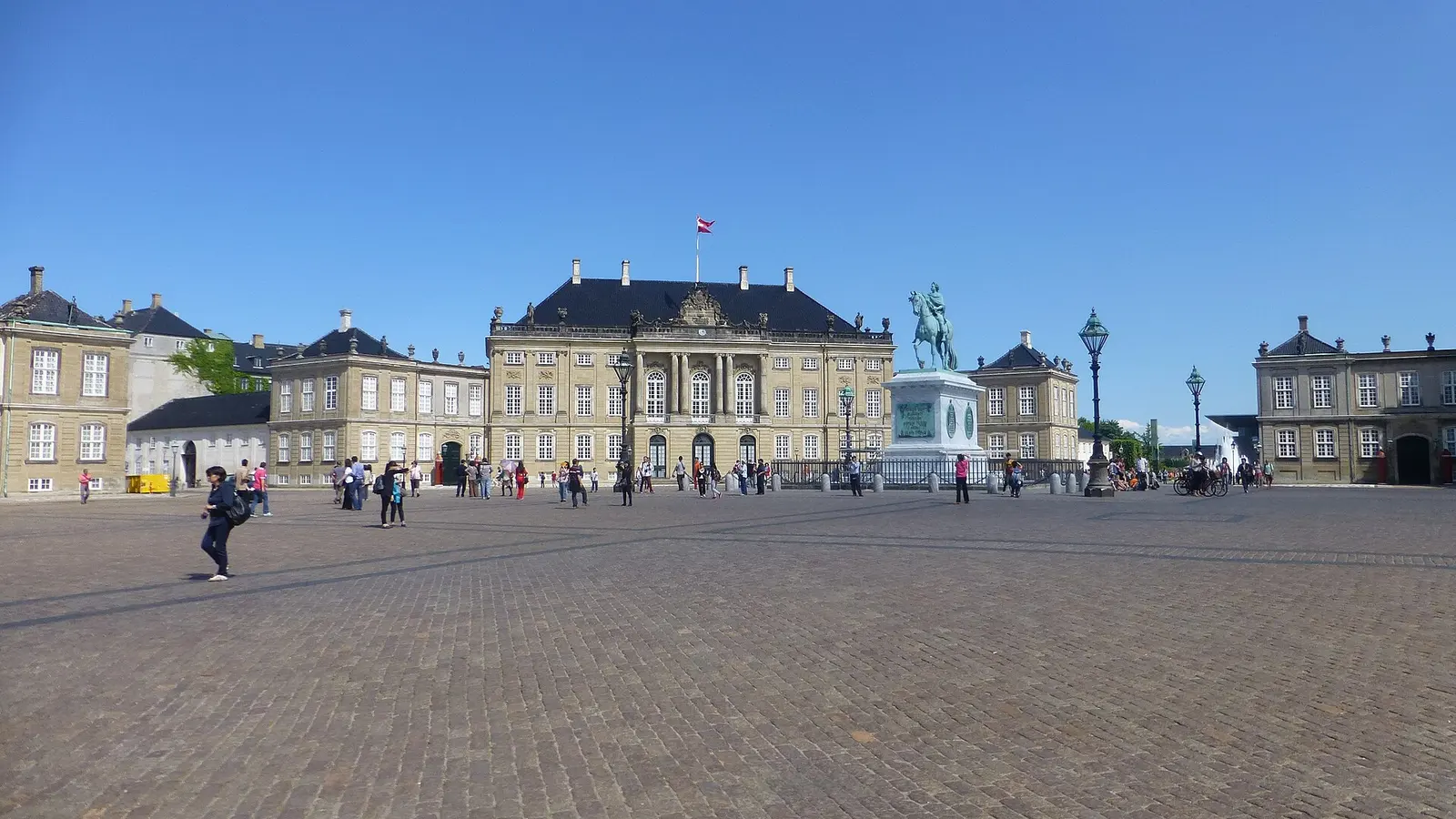
- The octagonal square (Amalienborgs Plads) — four rococo palaces, identical and symmetrical, built 1750s by Danish architect Nicolai Eigtved.
- The equestrian statue — Frederick V on horseback in the centre of the square, watching the ceremony.
- Christian VIII’s Palace museum — royal furniture, portraits, decor, and intimate items showing everyday royal life.
- Marble Church (Marmorkirken) adjacent — neoclassical church with a copper dome, 1794, free to enter and explore.
What to see at Amalienborg
Amalienborg is primarily an outdoor experience: watch the guard ceremony, photograph the square, admire the rococo architecture, and leave. The museum is quieter and more introspective than the busy square outside.
The Changing of the Guard ceremony

Every day at 12:00 noon, the Royal Guard marches from Rosenborg Castle (11:30 departure) to Amalienborg to perform the Changing of the Guard ceremony. The new guard arrives in formal uniform (red coats, bearskin hats), accompanied by a marching band (when state guests are present) or just drums (most days). They form ranks in the square, salute the royal standard, and formally relieve the previous guard. The ceremony is free to watch from the public plaza, takes about 15 to 20 minutes, and is a genuine working military ritual, not a tourist performance. If the Queen is in residence, the guard march is more elaborate and accompanied by a full band. Arrive by 11:45 for a good spot. It’s touristy, but it’s also genuinely Danish — this is real ceremony.
If the Queen is in residence (indicated by the royal standard flag flying above the palace), the guard march includes a full military band and is more spectacular. The flag is visible from the square.
The rococo square and architecture
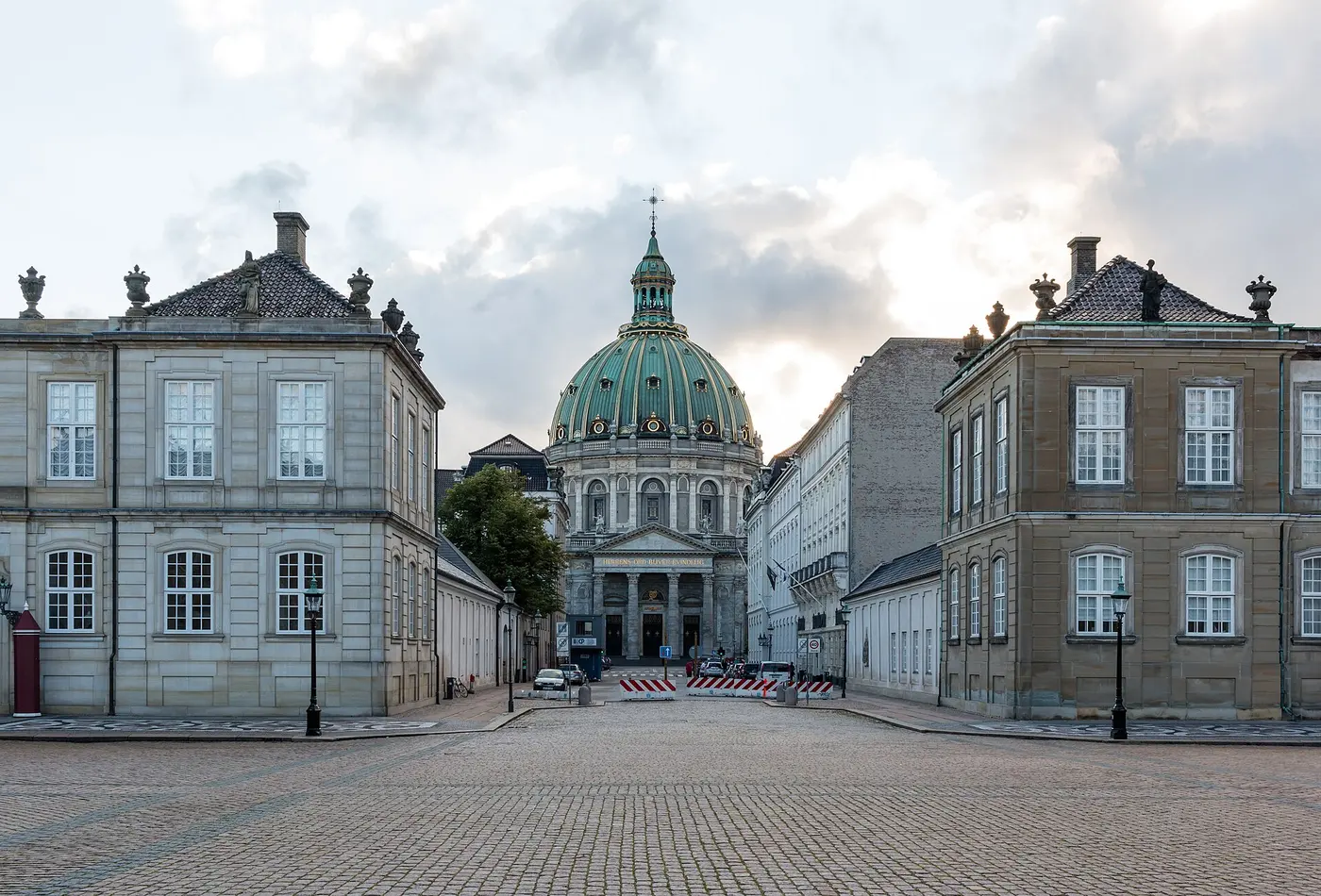
The square itself is the attraction: four identical rococo palaces (1750s) by Nicolai Eigtved, arranged symmetrically around an octagon. Each palace faces inward toward Frederick V’s equestrian statue in the centre. The north palace (Christian VIII’s) houses the museum. The east palace is the official residence of the Queen. The south and west palaces house senior royals. The architecture is perfect rococo: pale facades, mansard roofs, and symmetry everywhere. Walk around the square, study the facades, take photos (golden afternoon light is best, around 3 to 5 p.m.). The square itself is a living piece of 18th-century urban planning, and it works perfectly.
Christian VIII’s Palace Museum
The museum occupies Christian VIII’s Palace (northeast corner of the square) and shows the private royal apartments and everyday royal life across three centuries. You see royal bedrooms (small, surprisingly modest), dining halls, sitting rooms, and corridors lined with royal portraits and furniture. The collection spans rococo (1750s), neoclassical (1800s), and 20th-century decor. Audio guides (Danish, English, German, French, Swedish) narrate each room. It’s intimate and quiet, with few visitors. Allow 45 to 60 minutes. Most first-timers skip this and watch the guard ceremony instead, which is perfectly reasonable.
Marble Church (Marmorkirken)
The Marble Church (Frederikskirken) sits immediately adjacent to the palace square and is free to enter. Built 1774–1894 in neoclassical style with a distinctive copper dome (now green with age), it’s one of Copenhagen’s finest buildings. The interior is white marble and gold, with an ornate altar. It’s often open 10:00 to 17:00 daily (check ahead). The church steps are a popular photo spot overlooking the square. If the guard ceremony ends at 12:20 or so, walk over and spend 20 minutes in the church — it’s serene and beautiful.

Tickets and prices (2026)
| Ticket | Price | Covers | Book |
|---|---|---|---|
| Amalienborg Museum, adult | DKK 125 / EUR ~17 | Christian VIII’s Palace, royal rooms, audio guides | Book › |
| Amalienborg Museum, child 6-17 | DKK 60 / EUR ~8 | With adult | Book › |
| Amalienborg Museum, under 6 | Free | With paying adult | — |
| Amalienborg + Rosenborg combo | DKK 225 / EUR ~30 | Both palaces, both museums | — |
| Changing of the Guard ceremony | FREE | Public plaza, all performances (12:00 noon daily) | — (no booking needed) |
| Copenhagen Card | from DKK 599 / EUR ~80 (24 h) | Amalienborg + Rosenborg + Christiansborg + 75+ sites + transport | Is it worth it? |
Prices in EUR are approximate (DKK 7.45 per EUR). The guard ceremony is free and the main reason to visit. The museum adds depth if interested in royal decor, but most visitors skip it.
Opening hours (2026)
| Attraction | Hours | Notes |
|---|---|---|
| Square & guard ceremony | Always open; ceremony 12:00 noon | Daily, every day of the year |
| Christian VIII Palace Museum | 10:00–16:00 | Closed Mondays; closed during state events |
| Marble Church | 10:00–17:00 (variable) | Free entry, check ahead for services |
The square is always accessible. The guard ceremony happens daily at 12:00 noon (no exceptions). The museum is closed Mondays and occasionally closes for state events without notice—check ahead.
How much time to spend
Guard ceremony only: 30 to 45 minutes (arrive 11:45, watch until 12:20, take photos). Guard + Marble Church: 1 hour. Guard + museum: 1.5 to 2 hours. Guard + museum + Rosenborg (15 min walk): 3 to 3.5 hours.
Getting to Amalienborg
By metro or train
Take metro M2 to Kongens Nytorv (the historic square in the city centre). Walk northeast 5 minutes along Nyhavn embankment, or cut through the streets toward Frederiksstaden. The square is clearly signposted. From Central Station, walk 15 minutes: head east via Strøget, then aim for Kongens Nytorv and Nyhavn.
On foot or by bike
From the city centre (Rådhuspladsen): 15 to 20 minutes walk east, passing through Strøget and near Nyhavn. The neighbourhood is Frederiksstaden (an 18th-century planned district of elegant streets and neoclassical buildings). By bike: follow the main Copenhagen bike lanes along Nyhavn embankment or Bredgade. Bike parking is free and abundant at the square.
Nearby: what to combine with Amalienborg
Amalienborg sits at the north edge of the inner city, so nearby attractions are abundant. Nyhavn (5 min walk) is the colourful canal and historic waterfront. Rosenborg Castle and the Crown Jewels (15 min walk) are north. Christiansborg Palace and its free tower (10 min walk) are south. Kastellet fortress and the Little Mermaid statue (10 min walk) are north along the waterfront. The Marble Church (adjacent) is free to explore. A complete northern Copenhagen itinerary: Amalienborg (guard ceremony + square), Marble Church, Nyhavn, and a walk toward Kastellet (40 minutes total).
Dos and don’ts
Do
- Arrive by 11:45 to secure a good spot for the guard ceremony. Stand on the south or west side of the square for clear sightlines.
- Watch the guard march from Rosenborg (if visible). They depart at 11:30 and arrive exactly at 12:00. It’s a 20-minute march through the city.
- Combine with a walk to the Marble Church (5 minutes). The neoclassical dome and interior are stunning.
- Photograph the square in golden afternoon light (3 to 5 p.m.), when the rococo facades glow.
- Walk around the whole square to see all four palaces. Each has subtle architectural differences.
Don’t
- Don’t expect the guard ceremony to be a tourist spectacle. It’s a real military ritual. Respect the formality.
- Don’t skip the ceremony if you’re short on time—it’s genuinely Copenhagen’s most iconic daily ritual.
- Don’t come on Mondays if you want the museum. It closes Mondays. The square and ceremony are always open.
- Don’t miss the equestrian statue in the square centre. Frederick V has watched this ceremony for 250+ years.
- Don’t assume the museum is worth EUR 17 for a first visit. Most first-timers skip it, watch the ceremony, and leave satisfied.
Where to eat nearby
Amalienborg is in the elegant Frederiksstaden district, with many restaurants within walking distance. Immediate area: small cafes and upscale restaurants (EUR 20 to 50+). Nyhavn (5 min south): seafood and tourist restaurants, overpriced but atmospheric (EUR 15 to 35). Bredgade (west of square): fine dining and casual cafes (EUR 15 to 40). Kastellet (10 min north): a small cafe inside the fortress (EUR 10 to 20). City centre (10 min south): Strøget and Kongens Nytorv have all price ranges (EUR 8 to 60).
Did you know? Five Amalienborg facts
- Amalienborg was designed by Nicolai Eigtved in the 1750s as four separate aristocratic palaces arranged symmetrically around an octagon. The royal family didn’t move in until 1794, after Christiansborg Palace burned.
- The four palaces are named after Danish kings: Christian VIII’s Palace (museum), Frederick VIII’s Palace, Christian IX’s Palace, and Alexander III’s Palace. The Queen lives in Christian VIII’s Palace in winter and Frederick VIII’s in summer.
- The Changing of the Guard ceremony has happened at noon daily for over 200 years without interruption, even during Nazi occupation in World War II. It’s one of Europe’s most consistent royal rituals.
- The equestrian statue in the centre (Frederick V on horseback) was sculpted by Saly and completed in 1768. It weighs 40 tonnes and is one of the largest equestrian sculptures in the world.
- The nearby Marble Church (Frederikskirken) took 120 years to complete (1774–1894) and was almost abandoned due to cost overruns. Its copper dome oxidised from red to green over 130 years.
A short history
| Year | What happened |
|---|---|
| 1750s | Nicolai Eigtved designs four rococo palaces for the nobility around an octagonal square. |
| 1768 | The Frederick V equestrian statue is completed in the centre of the square. |
| 1794 | Christiansborg Palace burns catastrophically. The royal family moves to Amalienborg, establishing it as the permanent royal residence. |
| 1800s | The Marble Church is built next to the palaces (1774–1894). |
| 1940–1945 | During Nazi occupation, the Changing of the Guard ceremony continues daily without interruption — a symbol of Danish continuity. |
| Today | Amalienborg remains the winter residence of the Danish Queen. The guard ceremony attracts thousands of tourists daily. |
Frequently asked questions
What time is the changing of the guard?
Exactly 12:00 noon, every day (even weekends). Plan to arrive at 11:45 a.m. for a good view.
Is the changing of the guard always the same?
Yes, it’s ceremonial and follows the same routine daily.
Can I photograph the guard change?
Yes, it’s open to the public and photographers. Arrive early for a good spot.
Can I see the Queen?
Rarely. The Queen lives in one of the palaces, but she is not regularly visible. If the royal flag is flying on her palace, she’s home, but you won’t see her.
Is the museum tour worth it?
Probably not, unless you really like royal decor and furniture. The square and guard change are free and more memorable.
Can I eat near Amalienborg?
Yes, restaurants and cafes surround the square. Prices are on the high end (EUR 20 to 50 per meal), but views of the palace are included.